
Understanding Knee Injuries and How Proper Rehabilitation Can Restore Movement, Stability and Function
Introduction
The knee is one of the most important joints in the human body. It supports body weight, absorbs impact and allows us to perform everyday activities such as walking, running, climbing stairs, squatting and jumping.
However, because the knee is constantly exposed to physical stress, it is particularly vulnerable to injuries involving its ligaments, cartilage and surrounding structures.
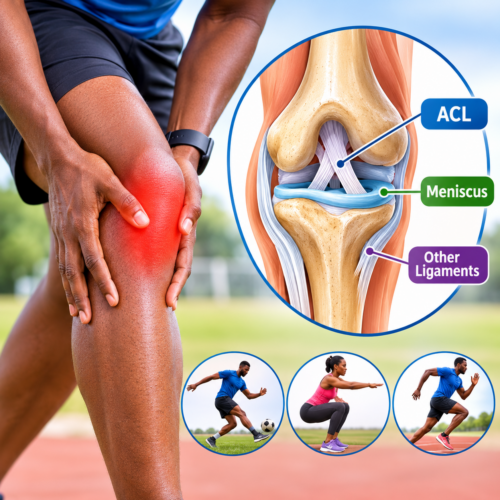
ACL injuries, meniscus tears and other knee ligament injuries are common among athletes, fitness enthusiasts and individuals involved in physically demanding activities. They can also occur during ordinary activities such as twisting, falling or making sudden movements.
Although these injuries may present with similar symptoms, they affect different structures of the knee and require appropriate assessment and treatment.
Understanding the causes, symptoms and treatment options is essential for preventing further damage and achieving successful recovery.
1. What Is an ACL Injury?
The Anterior Cruciate Ligament (ACL) is one of the four major ligaments responsible for stabilising the knee joint. It connects the femur (thigh bone) to the tibia (shin bone) and plays an important role in controlling forward and rotational movements of the knee.
The ACL helps:
- Prevent excessive forward movement of the tibia.
- Maintain knee stability during twisting and turning.
- Support controlled movements during jumping and landing.
- Provide stability during sudden changes in direction.
Causes of ACL Injuries
ACL injuries commonly occur during sporting activities involving sudden stops, pivoting, twisting or awkward landings.
Common causes include:
- Sudden changes in direction while running.
- Landing awkwardly after jumping.
- Rapid deceleration.
- Direct impact or collision during sports.
- Excessive twisting of the knee.
Sports such as football, basketball, rugby and netball involve movements that can increase the risk of ACL injuries.
Common ACL Injury Symptoms
Patients with ACL injuries may experience:
- A popping sensation at the time of injury.
- Rapid swelling around the knee.
- Pain and difficulty bearing weight.
- Reduced knee movement.
- A feeling of instability or the knee giving way.
ACL injuries can range from partial tears to complete ruptures. Treatment depends on the severity of the injury, associated damage, activity level and the patient’s functional goals. Some patients improve with structured physiotherapy, while others may require surgical reconstruction.
2. What Is a Meniscus Tear?
The meniscus consists of two C-shaped pieces of fibrocartilage located between the femur and tibia. Each knee has two menisci: the medial meniscus on the inner side and the lateral meniscus on the outer side.
These structures act as natural shock absorbers and play an important role in protecting the knee joint.
Their functions include:
- Distributing body weight across the knee.
- Absorbing impact during movement.
- Improving joint stability.
- Protecting the joint surfaces from excessive stress.
Causes of Meniscus Injuries
A meniscus tear commonly occurs when the knee twists while the foot remains firmly planted on the ground.
Other contributing factors include:
- Deep squatting under load.
- Sudden twisting movements.
- Sporting activities involving pivoting.
- Age-related degeneration of the meniscus.
- Repeated stress on the knee joint.
Common Meniscus Tear Symptoms
Patients may experience:
- Pain along the inner or outer knee joint.
- Swelling and stiffness.
- Clicking or catching sensations.
- Difficulty fully bending or straightening the knee.
- Locking or a feeling of restricted knee movement.
Not every meniscus tear requires surgery. Depending on the tear pattern, symptoms and functional limitations, treatment may involve conservative management and physiotherapy. Some tears, particularly those associated with persistent mechanical symptoms or significant structural damage, may require surgical assessment.
3. Understanding Other Knee Ligament Injuries
Apart from the ACL, the knee has three other major ligaments that work together to maintain joint stability.
Posterior Cruciate Ligament (PCL)
The PCL prevents excessive backward movement of the tibia relative to the femur. Injuries commonly occur following direct trauma to the front of the shin when the knee is bent, including certain road traffic accidents and sporting collisions.
Medial Collateral Ligament (MCL)
The MCL is located on the inner side of the knee. It provides stability and protects the joint against excessive inward movement. It can be injured when an impact forces the knee inwards.
Lateral Collateral Ligament (LCL)
The LCL is located on the outer side of the knee and helps prevent excessive outward movement. Injuries may occur following direct impact or abnormal forces applied to the joint.
Ligament injuries are generally classified into three grades:
- Grade 1: Mild stretching with minimal structural damage.
- Grade 2: Partial tearing with increased ligament laxity.
- Grade 3: Complete ligament rupture, often resulting in significant instability.
The severity of an injury influences the treatment approach and rehabilitation period.
4. How Are Knee Injuries Diagnosed?
Accurate diagnosis is essential because ACL injuries, meniscus tears and other ligament injuries can produce similar symptoms.
A healthcare professional may conduct a comprehensive assessment involving:
- Patient history and understanding how the injury occurred.
- Assessment of swelling, tenderness and pain.
- Evaluation of knee range of motion.
- Ligament stability tests.
- Muscle strength and functional movement assessment.
- Evaluation of walking patterns and weight-bearing ability.
Imaging may also be recommended where clinically indicated.
X-rays help identify fractures and certain bone abnormalities, while Magnetic Resonance Imaging (MRI) is particularly useful for evaluating soft tissue structures, including the ACL, PCL and menisci.
5. The Role of Physiotherapy in Knee Injury Rehabilitation
Physiotherapy plays an important role in the management and rehabilitation of many knee injuries.
The primary objective is not simply to reduce pain but to restore strength, mobility, coordination, stability and functional movement.
A structured physiotherapy programme may involve:
Pain and Swelling Management
Early management focuses on protecting the injured structure, controlling swelling and maintaining appropriate joint movement.
Restoring Range of Motion
Gentle and progressive exercises help improve knee flexion and extension while reducing stiffness and restoring normal movement.
Muscle Strengthening
Strengthening the quadriceps, hamstrings, gluteal muscles and calf muscles helps improve lower-limb function and support the knee joint.
Balance and Proprioception Training
Proprioception refers to the body’s ability to recognise joint position and movement. Following a knee injury, balance and coordination may be affected.
Specific exercises help retrain neuromuscular control, improve stability and support safer movement.
Functional and Sports-Specific Rehabilitation
For individuals returning to sports, rehabilitation may progress to controlled running, jumping, landing, acceleration and direction-changing exercises.
Progression should be guided by clinical assessment, functional recovery and individual rehabilitation goals.
6. Can Knee Injuries Be Prevented?
Although not all knee injuries can be prevented, certain strategies can help reduce the risk.
Consider incorporating the following habits into your routine:
- Strengthen the quadriceps, hamstrings and gluteal muscles.
- Include balance and coordination exercises.
- Practise proper jumping and landing techniques.
- Warm up adequately before physical activity.
- Increase exercise intensity gradually.
- Allow sufficient recovery between demanding training sessions.
- Address previous injuries and movement limitations.
- Maintain appropriate exercise technique during sporting and gym activities.
Injury prevention should be part of regular physical conditioning rather than something considered only after an injury occurs.
7. Returning to Normal Activities After a Knee Injury
Returning to normal activities too quickly is one of the challenges associated with knee injury recovery.
A reduction in pain does not necessarily mean that the knee has regained its full strength, stability and coordination.
Returning to sport before adequate rehabilitation may increase the risk of reinjury, particularly following ACL reconstruction.
A safe return-to-activity programme should consider:
- Adequate knee range of motion.
- Restored muscle strength.
- Good balance and coordination.
- Appropriate movement control.
- Confidence during functional activities.
- Successful completion of relevant functional tests.
The decision to return to sport should be made in consultation with the treating healthcare team.
Conclusion: Protect Your Knees Through Early Assessment and Proper Rehabilitation
ACL injuries, meniscus tears and other knee ligament injuries can significantly affect mobility, physical performance and quality of life.
However, appropriate assessment, timely intervention and structured rehabilitation can help many individuals regain function and return to their daily activities.
At Chirophysic Chiropractic and Physiotherapy Health Centre, we recognise the importance of understanding the underlying cause of musculoskeletal pain and developing appropriate management strategies.
Whether you are an athlete recovering from a sporting injury or an individual experiencing persistent knee pain, seeking professional assessment is an important step towards recovery.
Do not ignore persistent knee pain, swelling or instability. Early assessment can help identify the problem and guide appropriate treatment.
Your knees support you through every step. Give them the care they deserve.
Leave a Reply