
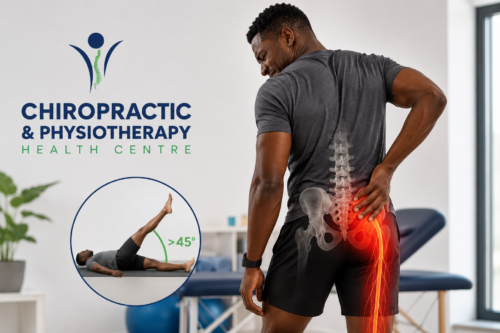
Many people walk into our clinic convinced they have sciatica. They describe pain running down the leg, tightness in the buttock, difficulty sitting for long periods, or discomfort when walking. While true sciatica does exist and can be extremely painful, I often find that many of these cases are actually caused by tight glute muscles irritating or compressing the sciatic nerve rather than a true spinal nerve problem.
At Chiropractic and Physiotherapy Health Centre, we regularly assess patients who have been self-diagnosing “sciatica” for months or even years. The good news is that muscular causes of sciatic-like pain often respond very well to the right chiropractic treatment, physiotherapy, stretching, and strengthening exercises.
What Is Sciatica?
True sciatica happens when the sciatic nerve is irritated or compressed at the spine, usually from conditions such as a slipped disc, spinal degeneration, or nerve root compression in the lower back. This often causes sharp, burning, or electric pain that travels from the lower back into the buttock and down the leg.
One of the most common clinical tests physiotherapists use is the Straight Leg Raise Test. When lying flat on your back, the affected leg is gently raised upward. In true sciatica, this movement is usually extremely painful and limited. Many patients struggle to raise the leg beyond about 30 to 45 degrees because the nerve becomes highly irritated.
However, if someone can comfortably raise the painful leg well beyond 45 degrees, there is a strong possibility that the pain may not be true sciatica but rather muscular tightness affecting the nerve.
Tight Glute Muscles Can Mimic Sciatica
The sciatic nerve runs through the buttock region and passes beneath several deep glute muscles, including the piriformis muscle. When these muscles become tight, inflamed, or develop trigger points, they can place pressure on the sciatic nerve and create symptoms that feel very similar to sciatica.
This is commonly referred to as piriformis syndrome or gluteal nerve irritation.
Patients may experience:
- Buttock pain
- Tightness in the hip
- Pain down the back of the thigh
- Tingling sensations
- Pain when sitting for long periods
- Discomfort during walking or climbing stairs
Unlike sciatica originating from the spine, these cases are usually more muscular in nature and often improve significantly with proper soft tissue treatment and rehabilitation.
Why Correct Diagnosis Matters
I always emphasize that not every pain running down the leg is sciatica. Misdiagnosis can lead to unnecessary fear, incorrect exercises, or delayed recovery.
A proper physiotherapy and chiropractic assessment helps determine:
- Whether the pain is coming from the spine
- Whether muscles are compressing the nerve
- If there is weakness or nerve damage
- Which movements worsen or relieve symptoms
- The best treatment approach for recovery
In many muscular cases, patients are relieved to learn that they do not have severe nerve compression or a major spinal condition.
How We Treat Sciatic-Like Pain
At Chiropractic and Physiotherapy Health Centre, treatment depends on the actual cause of the symptoms. For muscular compression around the sciatic nerve, treatment may include:
- Deep tissue therapy
- Dry needling
- Stretching exercises
- Chiropractic adjustments
- Physiotherapy rehabilitation
- Glute strengthening exercises
- Postural correction
- Mobility training
The goal is to reduce pressure on the nerve, restore proper movement, and prevent recurrence.
When Should You Seek Professional Help?
You should seek assessment if:
- Pain travels down the leg
- You experience numbness or tingling
- Sitting worsens symptoms
- The pain is persistent
- You have weakness in the leg
- Home stretching is not helping
The earlier the condition is identified correctly, the faster and safer the recovery process usually becomes.
If you are experiencing lower back pain, buttock tightness, or symptoms that feel like sciatica, our team at Chiropractic and Physiotherapy Health Centre can help assess the real cause and guide you toward the right treatment plan. You can conveniently book an appointment through the online booking page and begin your recovery journey. BOOK NOW
Written By,
Dion Njogu,
Chief Physiotherapist,
Chiropractic & Physiotherapy Health Centre
Comments
4 responses to “Is It Really Sciatica? Why Tight Glute Muscles Are Often The Real Problem”
Very important information I’ll follow the instructions.
I’m experiencing experiencing similar pain like sciatica nerve in my right leg, from buttocks down the thighs and behind knee
Hello Laurence,
Are you already under therapy for the same?
What is ur payment per sessions?
Hello,
Consultation 3,500
Physiotherapy 5,000 per session
Chiropractic 5,000 per session
The price per session might change depending with your insurance.