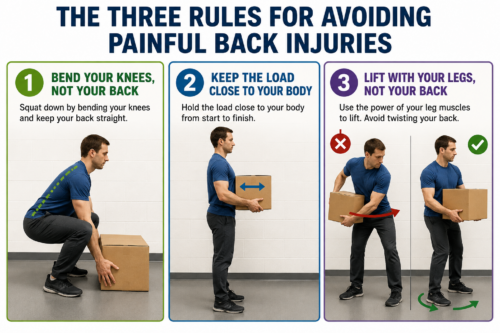
In a previous article, we talked about painful backs due to lifting weights. We promised to share with you some of the rules which you should take into consideration to avoid these back injuries. We will share with you three of these rules; keeping your chest forward, leading with the hips and not the shoulders, and keeping the weight next to your body.
1. Keep the Chest Forward
Always be sure to bend at the hips – not the low back. Most people believe bending their knees will ensure a safe lift, but this form alone can still lead to a back injury. The most important tip is to bend the hips and push the chest out, pointing forward. Also, one should never twist.
Bending the knees alone will still allow a person to curve the back and risk and injury, but keeping the chest pointing forward will guarantee a straight back. The back muscles will then be used most effectively for maintaining good posture, as they are designed to do. The knees will bend automatically so the muscles of the legs and hips will produce the power for lifting.
2. Lead with the Hips, Not the Shoulders
Twisting is another dangerous mistake that can lead to back injury. The shoulders should be kept in line with the hips to avoid this movement. For changing directions, move the hips first so the shoulders will move in unison.
When moving the shoulders first, the hips tend to lag behind creating the dangerous twisting that can cause back injury, especially to the joints in the back and pelvis.
Keep the Weight Close to the Body.
The further an object is held from one’s center of gravity, the more force required to hold that object up. For example, for most people it is not too difficult to hold a gallon of milk close to the chest, but it can be quite difficult to hold a gallon of milk stretched out in front at arm’s reach.
Of course, the milk does not get heavier when it is further from the body, but it does require much more force to hold it up. This extra force will also run through the lower back. Therefore, the closer the object is to one’s body, the less likely it is to lead to back injury.
ADDITIONAL LIFTING TECHNIQUES TO AVOID BACK INJURY
These three rules are applicable to most lifting situations. Following them whenever possible will reduce the amount of stress the back must go through during activity. This in turn makes a person less likely to sustain a back injury even when it is occasionally necessary to break the rules (when there is no other choice).
The following provides a quick overview of other safe approaches to lifting.
Golfer’s Lift
This technique is very useful to avoid back injury when lifting out of a bin or picking small objects off the floor, such as a golf ball.
For this technique, the knees do not bend. One leg is allowed to come off the floor behind the lifter and acts as a counter balance. The opposite hip bends and the body becomes almost parallel to the floor, except for the leg bearing the person’s weight. One arm reaches to pick up the object while the other is often hanging on a stationary object for support, such as a countertop or the top end of a golf club.
Although the chest does point down toward the floor, it is a safe technique since lifting the back leg allows the spine to stay straight and the counter balance offsets the strain on the back.
Using Momentum
This method is especially helpful to avoid back injury when lifting a heavy object above the level of the waist. If done correctly, it looks like a controlled toss of the object. The lifter can keep moving towards the destination of the object and swing it up to the surface. The object is then allowed to come away from the body and the momentum will help raise it, requiring less effort by the lifter.
Half Kneeling Lift Technique
The half kneeling lift is a highly effective lifting technique that can be used when picking up awkward, bulky, or heavy objects from the floor. This method helps reduce excessive strain on the lower back by allowing the lifter to use the powerful muscles of the legs and hips instead of relying solely on the back muscles.
To perform a half kneeling lift, position yourself behind the object with one knee resting on the ground and the other foot planted firmly in front of you. Keeping your back straight and your core muscles engaged, lift the object onto your bent front knee. This intermediate step reduces the distance the object must be lifted and helps maintain better control throughout the movement.
Once the object is securely resting on the front knee, the lifter has two options depending on the intended direction of movement. If moving forward, the back leg can be straightened to propel the body upward and forward.
Alternatively, if moving backward, the front leg can push against the floor to help lift the body into a standing position. Throughout the movement, it is important to maintain a neutral spine and avoid rounding the back. Although the chest may naturally point downward as the back leg straightens, the key principle is to keep the back straight and stable. This position helps distribute forces evenly through the hips, legs, and core muscles, significantly reducing stress on the lumbar spine.
The half kneeling lift is particularly useful for handling objects that are difficult to grasp, irregularly shaped, or positioned in tight spaces. It is commonly used in workplaces, warehouses, construction sites, gardening activities, and even everyday household tasks such as lifting storage boxes, bags of soil, or heavy packages.
Using proper lifting techniques such as the half kneeling lift can play an important role in preventing back injuries, reducing muscle strain, and promoting long-term spinal health. When combined with good posture, regular exercise, and core strengthening, this lifting method can help individuals perform physical tasks more safely and efficiently. Remember that no single lifting technique is suitable for every situation. Assess the weight and shape of the object before lifting, seek assistance when necessary, and use mechanical aids whenever available. Prioritizing safe lifting practices can greatly reduce the risk of injury and help maintain a healthy, pain-free back.
Again, not every situation allows a person to use perfect body mechanics while lifting. In many workplaces and daily activities, factors such as limited space, awkward positions, unexpected movements, or heavy loads may make it difficult to maintain ideal lifting techniques. However, making a conscious effort to use proper body mechanics whenever possible can significantly reduce the risk of back injuries and other musculoskeletal problems.
Proper lifting techniques involve keeping the load close to the body, bending at the knees and hips rather than the waist, maintaining a neutral spine, and avoiding twisting motions while carrying objects. These simple principles help distribute the load more evenly throughout the body and reduce excessive strain on the muscles, ligaments, and discs of the lower back.
Back injuries are among the most common causes of pain, disability, and missed workdays worldwide. Many of these injuries occur gradually due to repetitive poor lifting habits rather than a single traumatic event. By practicing safe lifting techniques consistently, individuals can protect their spinal health, improve their posture, and enhance overall physical performance.
Whether you are lifting boxes at work, carrying groceries, moving furniture, or picking up children, applying proper body mechanics can make a substantial difference. Combining good lifting habits with regular exercise, core strengthening, flexibility training, and maintaining a healthy body weight further reduces the likelihood of developing chronic back pain.
Remember, prevention is always better than treatment. Learning and applying safe lifting practices today can help keep your back strong, healthy, and pain-free for years to come.
Ready to feel better and move more comfortably? At Chiropractic & Physiotherapy Health Centre, our team is committed to helping you recover, relieve pain, and improve your quality of life through personalized chiropractic and physiotherapy care. Whether you are dealing with back pain, sports injuries, posture issues, or chronic discomfort, we are here to help. Book your appointment today through our online booking page and take the first step toward better health and wellness: Book an Appointment